In the ever-evolving digital landscape, businesses that thrive online are not the ones shouting the loudest — they are the ones speaking the most relevantly. Content marketing and SEO are two disciplines that, when combined strategically, create a compounding engine of organic growth. Yet many brands treat them as separate silos: marketers write content for audiences, and SEO teams optimize pages for search engines. The reality is that the most effective digital strategies blend both seamlessly.
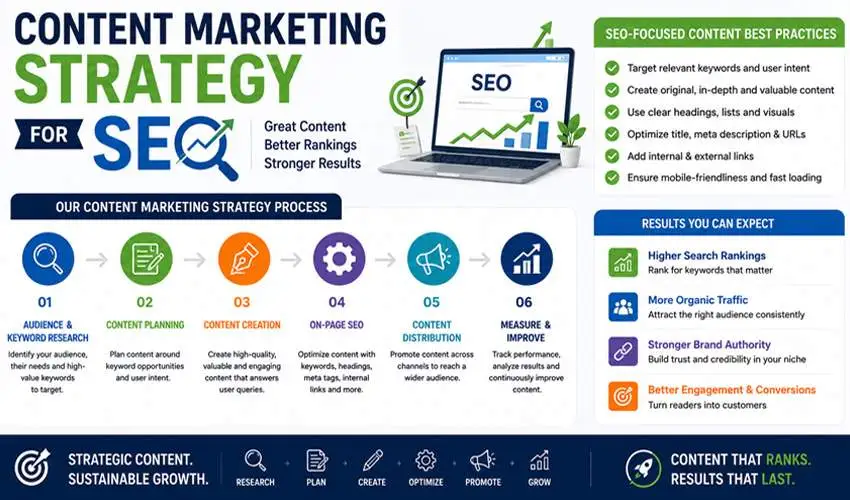
A well-crafted content marketing strategy for SEO is not about stuffing keywords into blog posts. It is about understanding your audience’s deepest questions, creating authoritative answers, and presenting them in a format that both humans and search engines can appreciate. This guide walks you through every essential component of building and executing that strategy — from foundational keyword research to content distribution and performance measurement.
Understanding the Relationship Between Content Marketing and SEO
Before diving into tactics, it helps to understand why content marketing and SEO are inseparable.
Search engines like Google rank pages based on relevance, authority, and user experience. Content is the primary vehicle through which a website demonstrates all three. Without content, there is nothing for search engines to index or rank. Without SEO, even the best content can remain invisible in a sea of competing pages.
Content marketing creates assets — articles, guides, videos, infographics, case studies — that attract and engage audiences. SEO ensures those assets are discoverable. Together, they form a feedback loop: quality content earns backlinks and engagement signals that boost domain authority, which in turn helps all future content rank more easily.
Step 1: Define Your SEO Content Goals
Every successful strategy begins with clarity of purpose. Before creating a single piece of content, define what you want it to achieve.
Common SEO content goals include increasing organic search traffic, generating leads or sales, building brand awareness, establishing topical authority, and earning natural backlinks. Each goal influences the type of content you create. A goal of driving immediate conversions, for instance, points toward product comparison pages and buyer’s guides. A goal of topical authority calls for a cluster of deeply researched educational articles.
Aligning content goals with broader business objectives ensures your strategy generates measurable ROI, not just page views.
Step 2: Conduct Deep Keyword Research
Keyword research is the backbone of any content marketing strategy for SEO. It tells you what your audience is actively searching for, the language they use, and how competitive various topics are.
Start by identifying seed keywords that represent your core topics. Use tools like Google Keyword Planner, Ahrefs, SEMrush, or Ubersuggest to expand those seeds into a broader list of related terms. Pay close attention to three variables: search volume (how often a term is searched monthly), keyword difficulty (how hard it is to rank for), and search intent (what the user actually wants to find).
Search intent deserves special attention. Keywords can be navigational (looking for a specific brand), informational (seeking knowledge), commercial (researching before buying), or transactional (ready to purchase). Matching your content type to search intent is critical. Writing an educational blog post for a transactional keyword, or a sales page for an informational one, will disappoint users and hurt your rankings.
Long-tail keywords — phrases of three or more words — are particularly valuable for newer websites. They tend to have lower competition, clearer intent, and higher conversion rates. Targeting a phrase like “best project management software for remote teams” may drive fewer visits than “project management software,” but those visitors arrive with a much more specific need and are far more likely to convert.
Step 3: Build a Topic Cluster Architecture
Modern SEO rewards websites that demonstrate comprehensive expertise on a subject. Topic clusters are the structural approach that makes this possible.
A topic cluster consists of a pillar page — a broad, authoritative piece covering a core subject in depth — surrounded by cluster content, which are more focused articles addressing specific subtopics. Each cluster article links back to the pillar page, and the pillar page links out to each cluster. This interlinking signals to search engines that your website offers thorough coverage of a topic area.
For example, a software company might create a pillar page on “project management” and surround it with cluster articles on “how to set project milestones,” “agile vs. waterfall methodologies,” “tools for remote team collaboration,” and “how to write a project brief.” This structure consolidates authority and improves rankings for the entire topic area, not just individual pages.
Step 4: Create High-Quality, Optimized Content
With research and architecture in place, it is time to create. High-quality SEO content is defined by two qualities: it thoroughly satisfies the searcher’s intent, and it is technically sound.
Satisfying search intent means writing content that actually answers what the user came to learn. If someone searches for “how to start a podcast,” they want a clear, practical guide — not a sales pitch for your podcast equipment store. Cover the topic comprehensively, address common questions, and present information in a logical, readable structure.
On-page SEO optimization ensures search engines can properly interpret your content. Key on-page elements include:
- Title tag: Include the primary keyword naturally, keep it under 60 characters, and make it compelling for click-throughs.
- Meta description: A 150–160 character summary that includes the target keyword and encourages users to click.
- URL structure: Short, descriptive URLs with the target keyword perform better than long, parameter-laden ones.
- Header tags (H1, H2, H3): Organize content with a clear heading hierarchy. Use the primary keyword in the H1 and related terms in subheadings.
- Internal links: Link to related pages within your site to distribute authority and guide users to additional content.
- Image alt text: Describe images with relevant keywords to improve accessibility and image search visibility.
- Content depth: Longer, more comprehensive content tends to rank better — but length for its own sake is not the goal. Substance is.
Step 5: Prioritize E-E-A-T
Google’s quality guidelines emphasize E-E-A-T: Experience, Expertise, Authoritativeness, and Trustworthiness. This framework was created to weed out low-quality, misleading, or shallow content — and it matters enormously for rankings in competitive niches, especially in health, finance, and legal topics.
Demonstrating experience means showing first-hand knowledge of the subject — real examples, original data, genuine insights. Expertise comes from depth, accuracy, and credentials. Authoritativeness is built over time through quality backlinks, mentions from reputable sources, and a strong brand presence. Trustworthiness is reinforced by transparent authorship, accurate information, clear sourcing, and a secure, well-maintained website.
Invest in building author profiles, citing reputable sources, and regularly updating content to keep it accurate and current.
Step 6: Promote Content and Build Backlinks
Creating great content is only half the work. Without promotion, even the most well-optimized articles may struggle to gain traction.
Backlinks — links from other websites to yours — remain one of the most powerful ranking signals in SEO. Earning them requires deliberate outreach and promotion strategies. Effective approaches include digital PR (publishing original research or data that journalists want to cite), guest posting on reputable industry websites, broken link building (finding broken links on relevant sites and offering your content as a replacement), and creating link-worthy resources such as free tools, original studies, or comprehensive guides.
Distributing content across social media, email newsletters, and relevant online communities (forums, Reddit threads, LinkedIn groups) also amplifies reach and drives early engagement signals that search engines interpret as validation.
Step 7: Measure, Analyze, and Iterate
A content marketing strategy for SEO is never static. Regular analysis reveals what is working, what is not, and where opportunities lie.
Key metrics to track include organic traffic (via Google Analytics), keyword rankings (via Ahrefs or SEMrush), click-through rate (via Google Search Console), average time on page, bounce rate, conversion rate, and backlinks earned. Set a regular cadence — monthly or quarterly — to review performance against your goals and update your content accordingly.
Content that is already ranking in positions 5 through 15 is particularly ripe for optimization. Improving those pages can yield significant traffic gains with less effort than starting from scratch.
Conclusion
A robust content marketing strategy for SEO is one of the highest-ROI investments a business can make. Unlike paid advertising, which stops the moment you stop spending, organic content compounds over time — each well-optimized article continues to attract visitors, generate leads, and build authority long after publication.
The formula is not complex, but it requires consistency: understand your audience, research what they search for, build a structured content architecture, create genuinely useful and optimized content, promote it effectively, and refine based on data. Businesses that commit to this cycle do not just rank higher — they become trusted resources in their industry, and that is an advantage no competitor can easily duplicate.